
Open Sesame
Write-ups at a glance
Write-ups at a glance
Search by Google:



Disclaimer: All material on the site, www.astrovidya.com are for entertainment purposes only and no guarantee is implied as to the accuracy of contents or advertisements contained in or linked to this website. The contents are based on ancient cannons of astrology and should not be interpreted as legal, financial, political, religious, ethical, medical, psychological, psychiatric or any other specialist advice. The user is wholly responsible for his choices, decisions, judgments and risks. In no event shall the site be liable for any direct, indirect, incidental, punitive or consequential damages of any kind whatsoever with respect to its service, materials and products. By using the services you confirm that you are over 18 and that you understand and agree with these terms of Disclaimer. If you disagree with any part of these terms and conditions, please egress the website.
MATCHING OF HOROSCOPES

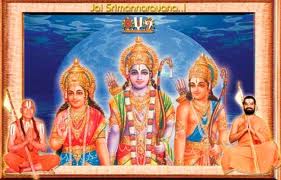
In a typical Hindu marriage, bride and bride-groom take an oaths before the sacred fire to the effect that their hearts are united and they have become permanent companions. धर्मे च अर्थे च कामे च मोक्षे च नाति चरामि। "In the matters of living (dharma), in financial matters, in fulfilling the desires and in spiritual progress, I will not move away from you". This is the mantra used in the process of Kanyadana. Mainly a Hindu marriage consists of Kanayadana (expression of intension of marriage), Mangalya dharana (wearing of a gold ornament called Mangalya. Mangala means for good), Panigrahana (holding hand) and Saptapadi (going round the holly fire, seven times). The bridegroom takes certain oaths called Ubhaya Vrata at the beginning on marriage to assure, he will not do anything hazardous ............................ like getting soaked in rain, climbing of trees and harboring suspicion. While tying Mangalya, he says, मांगल्यं तंतुनानेन मम जीवन हेतुना। कंठे बन्धामि सुभगे त्वं जीव शरदां शतं॥ "I tie this Mangalya in the thread, for my life. Let you live happily for a hundred years".
The Hindu Marriage Act, Section 437 regards marriage as complete and irrevocable when the 7th step of Saptapadi is complete. Saptapadi symbolizes the journey of life husband and wife travel hand in hand, like in the song 'Angelo' by the group 'Brotherhood of Man'. Unlike in the song, they do not run away, hand in hand but share their happiness with their families! इष एकपदी भव। ऊर्जे द्विपदी भव। रायस्पोषाय त्रिपदी भव। मयो भव्याय चतुष्पदी भव। प्रजाभ्यः पंचपदी भव। ऋतुभ्यः षट्पदी भव। सखा सप्तपदी भव॥ "Let the first step be for food (household or family). Let the second step be for strength (physical, mental and spiritual). Let the third step be for money (wealth and means of living). Let the fourth step be for fulfillment of desires (knowledge, happiness, mutual love, respect, understanding and faith). Let the fifth step be for children (responsible, healthy). Let the sixth step be for ritu (time, lifespan, to enjoy life in respective seasons, to conduct religious duties properly as per time-schedule). Let the seventh step be for friendship (loyalty and companionship)".
There is a subhashita in Sanskrit. रुणानुबंध रूपेण पतिपत्निसुतालयः। "It is fortune (anubandha) or misfortune (rina) that brings husband, wife, son and house". This article is intended for matching horoscopes for marriage an everlasting and perpetual arrangement and NOT for 'living-in' relationships which do not have sanction in any religion. In all the religions, wedlock is highly respected and recognised. Any temporary relationship is shunned upon. All most of the mammals - elephants, monkeys and human beings and some birds of course, desire to set up families than a casual relationship. Any marriage - be it an arranged marriage, a marriage with religious rituals, a registered marriage or a marriage solemnized by a rationalist, the desire is to be husband and wife for ever. None of the divorced people I have met, had married just for fun but wanted to live in marriage forever. Divorce does not bring happiness, it casts doubts on human relation. I do not mean the man or woman should remain within marriage, when their life, health and well being are threatened. Yet, I abhor divorces for flimsy reasons, which lacks human concern for each other. Manu smruthi catalogues various types of marriages including rakshasa vivaha (abducting the girl for marriage). Maharshi Manu has mentioned about single women and separated women but he does not classify types of divorces. There is only one type - and that certainly brings sorrow. It is worthy to be slow and patient in marriage and also in divorce. So, called love-proposals are made by young fellows to each other, without much thought, these days. Young generation has great sense of love, though they don't read Abhignan Shakuntala or Romeo & Juliet! But, they know how to throw an acid bulb. In a metro city, a man married and moved with his wife to US. In three months, the marriage fell apart, it is easy to get separated in US. The girl came back to India. After some time, when the boy was in India for some reason, they received divorce certificates. Both of them felt sorry, on the 4th day after divorce they married in a religious ashram (a reputed, indeed). After a week the husband called on the girl, to make arrangement to return to US. The girl declined to go with her married- divorced- remarried husband, as she was engaged to another person! They know not the sanctity of marriage....... or divorce. When a marriage proposal is made, the parents make elaborate enquiries about family background, character, physical features, education, financial status, profession, defects and diseases running in the family. It is not wise to jump to conclusions by what one comes across in self-appraisals, favorably disposed in matrimonial columns and sites. In marriage, the parties should not be self-centered but should think of other members of the family. A new girl who enters the family is not merely a wife but she also plays the role of daughter-in-law, sister-in-law etc., As far as possible, everybody's interest should be respected. Marriages based on fascination (misjudged as great love), sympathy, ideology to create a new world order or for wealth do not survive, but the ones with love, adoptability and mutual concern will go on forever. Marriage does not guarantee a 100% security but it is far more better than in 'living in' relationships, where one lives under constant fear that the person may go away.
The Hindu Marriage Act, Section 437 regards marriage as complete and irrevocable when the 7th step of Saptapadi is complete. Saptapadi symbolizes the journey of life husband and wife travel hand in hand, like in the song 'Angelo' by the group 'Brotherhood of Man'. Unlike in the song, they do not run away, hand in hand but share their happiness with their families! इष एकपदी भव। ऊर्जे द्विपदी भव। रायस्पोषाय त्रिपदी भव। मयो भव्याय चतुष्पदी भव। प्रजाभ्यः पंचपदी भव। ऋतुभ्यः षट्पदी भव। सखा सप्तपदी भव॥ "Let the first step be for food (household or family). Let the second step be for strength (physical, mental and spiritual). Let the third step be for money (wealth and means of living). Let the fourth step be for fulfillment of desires (knowledge, happiness, mutual love, respect, understanding and faith). Let the fifth step be for children (responsible, healthy). Let the sixth step be for ritu (time, lifespan, to enjoy life in respective seasons, to conduct religious duties properly as per time-schedule). Let the seventh step be for friendship (loyalty and companionship)".
There is a subhashita in Sanskrit. रुणानुबंध रूपेण पतिपत्निसुतालयः। "It is fortune (anubandha) or misfortune (rina) that brings husband, wife, son and house". This article is intended for matching horoscopes for marriage an everlasting and perpetual arrangement and NOT for 'living-in' relationships which do not have sanction in any religion. In all the religions, wedlock is highly respected and recognised. Any temporary relationship is shunned upon. All most of the mammals - elephants, monkeys and human beings and some birds of course, desire to set up families than a casual relationship. Any marriage - be it an arranged marriage, a marriage with religious rituals, a registered marriage or a marriage solemnized by a rationalist, the desire is to be husband and wife for ever. None of the divorced people I have met, had married just for fun but wanted to live in marriage forever. Divorce does not bring happiness, it casts doubts on human relation. I do not mean the man or woman should remain within marriage, when their life, health and well being are threatened. Yet, I abhor divorces for flimsy reasons, which lacks human concern for each other. Manu smruthi catalogues various types of marriages including rakshasa vivaha (abducting the girl for marriage). Maharshi Manu has mentioned about single women and separated women but he does not classify types of divorces. There is only one type - and that certainly brings sorrow. It is worthy to be slow and patient in marriage and also in divorce. So, called love-proposals are made by young fellows to each other, without much thought, these days. Young generation has great sense of love, though they don't read Abhignan Shakuntala or Romeo & Juliet! But, they know how to throw an acid bulb. In a metro city, a man married and moved with his wife to US. In three months, the marriage fell apart, it is easy to get separated in US. The girl came back to India. After some time, when the boy was in India for some reason, they received divorce certificates. Both of them felt sorry, on the 4th day after divorce they married in a religious ashram (a reputed, indeed). After a week the husband called on the girl, to make arrangement to return to US. The girl declined to go with her married- divorced- remarried husband, as she was engaged to another person! They know not the sanctity of marriage....... or divorce. When a marriage proposal is made, the parents make elaborate enquiries about family background, character, physical features, education, financial status, profession, defects and diseases running in the family. It is not wise to jump to conclusions by what one comes across in self-appraisals, favorably disposed in matrimonial columns and sites. In marriage, the parties should not be self-centered but should think of other members of the family. A new girl who enters the family is not merely a wife but she also plays the role of daughter-in-law, sister-in-law etc., As far as possible, everybody's interest should be respected. Marriages based on fascination (misjudged as great love), sympathy, ideology to create a new world order or for wealth do not survive, but the ones with love, adoptability and mutual concern will go on forever. Marriage does not guarantee a 100% security but it is far more better than in 'living in' relationships, where one lives under constant fear that the person may go away.
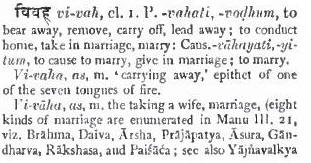
Monier Williams, in his "A Sanskrit-English Dictionary", published in 1872 by Oxford University Press gives the meaning of vivaha (marriage) as vi-vaaha - to conduct home, to take as wife. Marriage is referred to as a specific 'samskara', Vivaha, is the word used for the marriage rituals, Vaha meaning to carry. That is to say, it goes on for ever, a permanent bond that should go on for next seven births. In all the religions, marriage is a celebration for the whole family and there are rituals and mantras, associated with that. But there are no celebration for divorce and separation. World over, everybody aspires to have a permanent relationship to bring up the family. Marriage is a social institution. "It is a union of persons of different gender to fulfill their 'personal desires' and to have progeny, with social acceptability. A marriage is a legal, physical and moral union of husband and wife to establish a family. The ritual of marriage gives public acknowledgment with the blessings of well wishers. Marriage has a religious orientation where all the family members rejoice.
Monier Williams, in his "A Sanskrit-English Dictionary", published in 1872 by Oxford University Press gives the meaning of vivaha (marriage) as vi-vaaha - to conduct home, to take as wife. Marriage is referred to as a specific 'samskara', Vivaha, is the word used for the marriage rituals, Vaha meaning to carry. That is to say, it goes on for ever, a permanent bond that should go on for next seven births. In all the religions, marriage is a celebration for the whole family and there are rituals and mantras, associated with that. But there are no celebration for divorce and separation. World over, everybody aspires to have a permanent relationship to bring up the family. Marriage is a social institution. "It is a union of persons of different gender to fulfill their 'personal desires' and to have progeny, with social acceptability. A marriage is a legal, physical and moral union of husband and wife to establish a family. The ritual of marriage gives public acknowledgment with the blessings of well wishers. Marriage has a religious orientation where all the family members rejoice.
There is a subtle difference between a Western and Indian astrologer. Like general matching of a Western astrologer, we too have list of 'paniki raadu' (not workable) stars, many short cuts and several deaf and dumb rules. A wise Western astrologer further examines mutual positions of significators of marriage - whether they are in squares, trines, angles etc., He will make individual analysis of both charts before he pronounces his judgment. Most of the Indian astrologers use a ready reckoner, kuja dosha and a list of 'always bad' stars of girls, like Moola. Some 30 years ago, one client told me, I spend lot of time on matching charts, but his expert 'guru' simply examines the charts for few seconds. Even now, I do not skip through the charts, I have not learnt the lesson, my client wanted! Indian astrologers, I think, should be more inquisitive, more elaborate in examining the charts, instead of quoting a nadi dosha, a kuja dosha or a kalasarpa yoga. In the mean time, my western counterpart should develop more tools based on Indian system.
Honestly, I do not go with all the jargon of astrology but, I base my arguments on valuable dictums. There are delicious fruits as well as poisonous ones. We do not eat all of a mango, we know what to eat and what to throw away. As we proceed further, we will come across deviations and exceptions. We will also explore why some marriages, judged as getting 30/38 marks miserably failed. I do not intend, you should start matching right after Part-I of this article or open another "Vedic Research Institute for matching." Hold on, till you read all the articles in the series. A example ready reckoner is here, though other panchangas give slightly variable values. As the matching is considered between stars and rasis, one need to know the stars of the boy and girl. Nine padas of stars go into a rasi, so we can know the rasi of the person, if we know the star pada. In these tables, you will find a number where the star and pada of the girl and the boy will intersect. If that number is more than 18, marriage can be agreed. The reckoner is prepared considering various concepts in both girl's and boy's chart. Matching is done from girl's star and not from boy's star. Before consulting the reckoner, one should make sure that the star stated by the party is correct. You can verity the accuracy of given data using any on-line soft ware and ensure that same ayanamsha (or, say soft ware) is used to make both the charts of boy and girl. Depending on various yard sticks used by panchanga makers, the total marks obtained may differ from one panchanga to other. This over simplified x and y-axis matching has brought disgrace to astrology - many good matches are being rejected and wrong matching are made. You might have seen disgruntled divorces saying, "Matching was approved by the Panditji with 25 marks". It is prudent then, to delve a bit deeper and find out the compatibility based on various principles that went into a ready made tables. The birth data should be checked by preparing a full horoscope. We should wade through the shallow interpretations which are at times used for convenience sake and also rich and clear directives. The best way to decide which are dependable and which are not, hinges largely on personal experience - unbiased and inquisitive. "మా గురుగారు ఇట్ల ఉపదేశించారు - Maa guru garu itla upadeshincharu" principle (my guru preached this) will not go a long way. With due respect to one's guru, the astrologer should set sail to find the applicability, limitations and exceptions with diligence.
Honestly, I do not go with all the jargon of astrology but, I base my arguments on valuable dictums. There are delicious fruits as well as poisonous ones. We do not eat all of a mango, we know what to eat and what to throw away. As we proceed further, we will come across deviations and exceptions. We will also explore why some marriages, judged as getting 30/38 marks miserably failed. I do not intend, you should start matching right after Part-I of this article or open another "Vedic Research Institute for matching." Hold on, till you read all the articles in the series. A example ready reckoner is here, though other panchangas give slightly variable values. As the matching is considered between stars and rasis, one need to know the stars of the boy and girl. Nine padas of stars go into a rasi, so we can know the rasi of the person, if we know the star pada. In these tables, you will find a number where the star and pada of the girl and the boy will intersect. If that number is more than 18, marriage can be agreed. The reckoner is prepared considering various concepts in both girl's and boy's chart. Matching is done from girl's star and not from boy's star. Before consulting the reckoner, one should make sure that the star stated by the party is correct. You can verity the accuracy of given data using any on-line soft ware and ensure that same ayanamsha (or, say soft ware) is used to make both the charts of boy and girl. Depending on various yard sticks used by panchanga makers, the total marks obtained may differ from one panchanga to other. This over simplified x and y-axis matching has brought disgrace to astrology - many good matches are being rejected and wrong matching are made. You might have seen disgruntled divorces saying, "Matching was approved by the Panditji with 25 marks". It is prudent then, to delve a bit deeper and find out the compatibility based on various principles that went into a ready made tables. The birth data should be checked by preparing a full horoscope. We should wade through the shallow interpretations which are at times used for convenience sake and also rich and clear directives. The best way to decide which are dependable and which are not, hinges largely on personal experience - unbiased and inquisitive. "మా గురుగారు ఇట్ల ఉపదేశించారు - Maa guru garu itla upadeshincharu" principle (my guru preached this) will not go a long way. With due respect to one's guru, the astrologer should set sail to find the applicability, limitations and exceptions with diligence.